Showing posts with label Canada. Show all posts

Thursday, February 25, 2016

The Engineering Community in Canada and The Power of Networking


Q: How about forming strong and professional relationships with people in your field or potential clients? Does this contribute to your success?

A: I would say that we all are in sales! Selling is a game. Life is a game. Both have their rules… and attitude is everything! The key to success is handling failure. A strong positive attitude is one of the most important traits, not only for a sales professional, but for everyone who wants to build strong relationships and succeed in any undertaking! Not always is easy to keep a positive attitude, but whatever you focus on becomes your reality, believe it or not. AREC’s purpose is to help you make better use of your professional network and help the people you trust in return. Improve your performance with the guidance of peers and mentors who’ll help you stretch and achieve your full potential. Be part of something bigger than yourself. “Let’s Connect and Build Relationships” is one of our objectives.
Speaking of AREC’s successes, an important part of that is because of our sponsors and partners, and I’d like to thank them again for their continuous support.  Some of them were with us from the beginning, others have joined us recently, and we at AREC appreciate you all!
Imagine that you have access to a pool of thousands of highly skilled internationally trained engineers from a wide array of expertise, qualified to match your business needs (such as recruitment or tapping in diverse markets)… this is AREC! (www.arec.ca)


Read more...
http://besocialevents.ca/creating-a-non-profit-organization-the-power-of-networking/

Wednesday, August 21, 2013

Online resources help develop career plans by Sheryl Smolkin

The basic building blocks of a career plan are an inventory of your skills, abilities and the activities that you enjoy.

When you need money to pay the rent, it is often necessary to take the first job that comes along, even if it is not ideal. However, if you don’t have a career plan, several years later you may find yourself in the same dead end position.
The basic building blocks of a career plan are an inventory of your skills, abilities and the activities that you enjoy. Then you need to research the kinds of careers that are consistent with your aptitude and any further education or training you may need to qualify for the career you have chosen.
Most college and universities have career centres that offer counseling and resources to graduates and alumni. The websites below can also help.
Read more here.

Wednesday, July 17, 2013

Never Let a Job Description Talk You Out of That Job by Sam

Nothing to lose– Everything to gain – A great job to get:
Everyone has looked at countless job descriptions in their lifetime – let’s face it, even if you’re not even remotely considering a career move – happy, happy, happy in your job right now, chances are you have been direct recruited in the last six months or so (more than once I am sure) – by someone pitching you on the most fantabulous job with the most wonderful company with the best growth opportunity. Just start by looking at the job description……On the flip side, recruiters looking to hire have to weed through mountains of resumes – the good, the bad and the totally unqualified. Resumes and job descriptions are the international currency of the talent business. Believe you me if we took either of them at absolute face value, we would all be in trouble because so, so much is missed in the in the written word, lost without the cultural and passionate nuances and missed in the simple black and white translation.
Any successful first call between a qualified candidate and a Recruiter tends to end with the candidate wanting to see a job description before moving forward to a potential next step. And that’s certainly fair game. Why wouldn’t one want to see whether the nitty-gritty of a job is really of interest. But here’s the rub, don’t let a (potentially poorly or incomplete) written job description possibly remove you from pursuing a potential role before you really understand the full story.
Read more here.

Friday, July 5, 2013

WHAT CANADA HAS IN COMMON WITH YOU, EH!

Happy belated Canada Day weekend!  

When you think Tim Horton's, Hockey Night in Canada, the Rockies, weather and Tommy Douglas what is the first word that comes to mind? I'll wager it's "Canada," eh! These are some of the distinctive elements that make up our unique national identity.  
This week's podcast is with Roy MacGregor, a gifted Canadian story-teller, author and Globe & Mail columnist. Roy asks "Why is identity so important? A separate national identity is key when you live so closely to a large influential country like the United Sates. We even speak differently in our little world".  
Countries and professionals that are successful in the competitive global marketplace have a number of things in common: a clear and distinct identity, something to offer that the market needs, and a certain pride in themselves. 
Roy has invested his career discovering and sharing what makes Canada a wonderful and complex place to live and work. Appropriately, he started writing for The Canadian, then worked for Maclean's, The Ottawa Citizen, and The National Post. Now, he writes a daily columncalled My Country. Over the past 35 years, Roy has traveled from St. Johns to Victoria. He is a keen observer and has written a number of books that are a powerful reminders of who we truly are. 
What does Roy love about Canada? " I love the people. I love the fact that they have amazing stories - very moving, very sweet. It has always been the people for me."
On a more personal note, I myself immigrated to Canada as a young boy. My parents came here seeking new opportunities. They wanted to give me a better life, and I am very thankful. I think our country is a splendid hybrid of Europe and the United States, offering us the best of both.
Happy Birthday Canada!
Standing on guard for thee, along the road with you!

Alan

P.S. Looking for a new and better opportunity?. The Career Transition Program is a one to one coaching program designed to help you put together a plan to ensure a smooth, successful transition in a challenging market. Call or email us for more details.   

P.S. Join our CareerClass Webinar | Get The Right Career, Right Now!: Wed, July 3: 12-12:45 P.M. ET. Invest 45 minutes of your time and learn the steps to identifying the career path that's right for you.  Click for more details & to register.

http://www.careerjoy.com/blog/mmm-what-canada-has-in-common-with-you-eh-monday-morning-motivator?utm_source=Copy of FLR June 27, 2013&utm_campaign=6/14/13&utm_medium=email

Thursday, October 18, 2012

York Region’s IEP Conference, October 23, 2012

The Gateway, York Region's first conference for internationally educated professionals (IEPs), provides an opportunity for IEPs, newcomer entrepreneurs, employers, professional associations and government representatives to make new contacts, exchange ideas and learn from each other.

Fore more details check here.

Friday, September 28, 2012

Business Edge for Internationally Educated Professionals


Business Edge is for internationally educated men and women who are building careers in Canada. It helps you build professional confidence and acquire the relevant business skills you need to advance your career. The program will help you understand the subtleties of the Canadian workplace and learn new strategies for success.


We are now accepting applications for the fall offering of the program that starts on November 10th, 2012.  
Sabina Michael
Program Manager

Rotman School of Management
University of Toronto
105 St. George Street
Toronto, ON M5S 3E6
Tel: 416.978.7059
Fax: 416.978.5549

www.rotmanexecutive.com/businessedge

AREC link.

Wednesday, August 15, 2012

Newcomers face unique job search challenges By Kyla Frankowski


This is the fourth part in a series of columns to offer job search tips and advice, written by Lutherwood staff. Lutherwood is a local agency that offers employment support as well as a range of other services which are accessed by more than 20,000 people annually in Waterloo Region and Wellington County.
Newcomers to Canada often face many challenges when looking for work that fits their past experience.
These challenges can include differing work environments, qualification requirements and workplace cultures, as well as a lack of a social network.
However, there are some basic steps you can take to ensure you are on the right track.
If you are new to Canada and looking for work, you need to know how your skills and previous occupation fit into the Canadian labour market. So your first step is to find out which Canadian occupation best matches your experience and skills.
Recently, I worked with an individual who held the title of electrical engineer in his native country.
But when we reviewed his skills and work experience, we discovered that he better matched the occupation of industrial millwright here in Canada. Knowing this, we were able to focus his job search efforts.
The second step is to learn what skills and experience Canadian employers are looking for, review your own skills and experience, and identify any gaps.
To determine Canadian employers’ needs, you should review job postings, talk to employers and talk to people working in your field.
Ideally, you should try and connect with someone who has been successful getting work in your profession so that you can learn what worked or didn’t work for them.
Now that you know what type of job you are looking for and any skill and experience gaps you need to fill, the third step is to create a plan to fill those gaps.
There are many options for upgrading skills and increasing experience, including programs designed specifically for newcomers to Canada. These options include mentoring with someone working in your field, accessing apprenticeship opportunities and enrolling in English-language or job-skill upgrading courses.
Once the gaps are filled, you are in a position to work on your resumé, prepare yourself for interviews and find employers who are hiring in your field.
Finally, build a network. Finding work in today’s economy is difficult enough without trying to do it on your own. A network is a group of people who know you, know what kind of work you are looking for and will help you.
Try to include people who have successfully adapted to the Canadian workplace and culture as well as people working in your field and industry of interest. Find out what job opportunities they know about and who they know that can help you with your job search.
I strongly advise speaking with someone at a local government-funded employment services agency.
Employment advisors can help you focus your job search, identify skill and experience gaps, help you access employment programs, identify training and financial assistance opportunities such as Second Career, and give you guidance on preparing for your job search.
Adapting your professional skills and experience to fit within a new country is challenging.
But with a bit of time, dedication and support, you may be surprised at how quickly you can find the work you are looking for.
• • •
Kyla Frankowski, an employment advisor at Lutherwood, has more than eight years of experience offering employment services. She works primarily with newcomers to Canadain the Job Search Workshop program. For more information, visit www.lutherwood.ca/employment.

Thursday, December 22, 2011

News You Can Use - Personal networks and the economic adjustment of immigrants by Derrick Thomas

In searching for explanations as to why recent immigrants are having more difficulty adjusting to the Canadian economy than did their predecessors, researchers have looked at aspects of human capital such as language ability, literacy, education and work experience. A factor that has not often been considered is the social capital of immigrants—that is, the personal networks that they are able to mobilize in their economic interests. Read more. 

Monday, November 28, 2011

Nominations are now open for Top 25 Canadian Immigrants of 2012


It's that time of year again!
Canadian Immigrant Magazine, in association with RBC Royal Bank, is proud to announce the nominations for the 2012 Top 25 Canadian Immigrants Awards.
Please visit our website today to nominate an immigrant you know who has motivated or inspired other people. It only takes a few minutes of your time.
This national people's choice award is unique in that it allows Canadians to nominate and vote directly for individuals from all walks of life who have made a difference since their arrival in Canada. Over 400 individuals were nominated from across Canada in the 2011 awards program. So, we want to hear from you today! We believe that new Canadians are making a difference in their newly adopted country and it is important that they are recognized.
Questions about the program? Please click here for FAQ's and for nominee criteria.
Can't find the information you're looking for in our FAQ? Email Madelaine Gileadi at mgileadi@starmediagroup.ca for answers to all your questions regarding this program.
Interested in seeing who the Top 25 of 2011 are? Click here to see last year's winners.

Sunday, July 24, 2011

News You Can Use - Citizenship Study Guide

Discover Canada was updated on March 14, 2011. The citizenship test is based on the information in Discover Canada, but you do not need the updated version to prepare for the citizenship test. The test does not contain questions on the new material. To prepare for the citizenship test, you can study any copy of Discover Canada issued by the Government of Canada since November 12, 2009.


Study Guide - Discover Canada The Rights and Responsibilities of Citizenship


Free Online Canadian Citizenship Practice Test (Discover Canada)

Discover Canada: Sample study questions


2011 Canadian Citizenship Test Passing Guide

Thursday, June 23, 2011

Putting safety first with language training

The ABCs of safety

Clear and effective communication is critical for employees in safety-sensitive jobs, says Lesley MacDonald, Manager of Diversity and Top Employer Strategy at BC Hydro. With more and more skilled talent coming from outside Canada, BC Hydro offers occupation-specific language training for employees who have identified their language skills as a barrier to communicating effectively with team members.
To make language training as successful as possible, MacDonald has the following tips:
  • Provide employees with opportunities to practise what they have learned in language classes to maintain and build their new skills.
  • Integrate language and cross-cultural communication training into the organization’s larger strategic context.
Learn more about BC Hydro’s language and cross-cultural communication training programs in this Success Story.

Tuesday, May 17, 2011

7 Success Secrets for Canadian Immigrants

Nick Noorani
Nick Noorani, founding publisher of Canadian Immigrant magazine and bestselling author of Arrival Survival Canada, will be hosting a FREE SEMINAR.
Nick's message is one of positive thinking, embracing Canada as your new home, and creating opportunities through risk-taking and community participation.
His frank and humorous presentations draw on his immigrant journey and on success tories from the many newcomers he has met along the way.
Nick’s speeches have had a profound effect on his audience. Now it's your turn! Join Nick and learn the secrets to successful immigration in Canada.
Admission is free by pre-registration only. Seating is limited, so register today!

Sunday, May 15, 2011

Fabricating our Future

Marie Laird SME Chair
Marie Laird, Chair, SME Toronto

There's a connection between the decline in manufacturing and the decline in the middle class. If we don't reverse the trend, we can look forward to careers in the service sector.
  
"Industry classification systems used by the government commonly divide industry into three sectors: agriculture, manufacturing, and services. The primary sector of industry is agriculture, mining and raw material extraction. The secondary sector of industry is manufacturing. The tertiary sector of industry is service production." (Wikipedia)

It's no secret that our country has progressed through the various stages of industry described above similar to most developed nations.  We started as farmers, fishermen, lumberjacks and miners - and progressed to the production of manufactured goods during the Industrial Revolution.

We have now moved into the tertiary sectors as evidenced by the fact that the service sector has grown to account for 71.3% GDP and 76% of the labour force (2009 stats). Higher commodity prices have helped revitalize certain primary industries, but manufacturing has continued to decline from a high of 29% of GDP in 1944 to only 13% of GDP and 13% of the labour force in 2010.

What do these statistics mean? Has our standard of living continually increased - in line with our progression through each of these stages?

When did Canada have the greatest sense of prosperity? When did people in Canada and people coming to Canada, on average, have the most positive outlook for themselves and their children? 
The answer is, "Not now." 

I'm not suggesting that life in Canada hasn't improved in many ways since we were primarily hewers of wood and drawers of water, or even when we were heavily focused on manufacturing.

However a high standard of living is more than just owning material goods once considered luxuries. The opportunity for all members of society to make a contribution, earn a good wage, and live a healthy life in a clean and safe environment plays a much larger role than often credited. A critical indicator of a high standard of living is a shared sense of hope for a better future.

For some people the good times continue. Unfortunately for increasing numbers, such as those formerly employed in manufacturing, the future is quite bleak and the gap between the rich and the poor continues to widen as opportunities for the middle class disappear.

Our collective hope for a better future is in decline and we no longer have confidence that life, in general, will continue to improve.

I looked at some average weekly wages by industry for 2010. Mining and oil and gas extraction had the highest average -$1700 per week (no surprise with commodity prices soaring). Forestry averaged $950 and manufacturing $960.

In the service sector, public administration (government jobs) averaged $1094 per week and finance and insurance industries came in at $1049.   However, there were other service sector positions which were much lower. Those in accommodation and food services, for example, earned an average of $354 per week and those in retail earned an average of $500 per week.

I couldn't find the answer, but I'd like to know the average wage in the service sector. I would bet that as we move more and more toward a service sector economy that our average wage as a nation will decrease...and that we will be more harshly divided between the upper class and the lower class with little in between.

Historically manufacturing played a strong role in the development and maintenance of the middle class. As manufacturing has declined, so too has the middle class.  Jobs in oil and gas, finance, insurance have not filled the gap. That's not to say those industries and jobs don't have a place...it's just a question of balance.

The service sector cannot revive the middle class.
So why are we still letting manufacturing decline? 

All the best!

Marie Laird
Chair
Society of Manufacturing Engineers Toronto

e: marie.laird@smetoronto.ca
w: http://www.smetoronto.ca
Advancing Manufacturing in Ontario

Saturday, April 30, 2011

Canadian Diaspora


A Somalian arrives in Vancouver as a new immigrant to Canada. He stops the first person he sees walking down the street and says, ”Thank you Mr. Canadian for letting me in this country, giving me housing, money for food, free medical care, free education and no taxes!”
The passerby says, ” You are mistaken, I am Mexican.”
The man goes on and encounters another passerby. ”Thank you for having such a beautiful country here in Canada!”
The person says, ”I not Canadian, I am Vietnamese.”
The new arrival walks further, and the next person he sees he stops, shakes his hand and says, ”Thank you for the wonderful Canada!”
That person puts up his hand and says, ”I am from Middle East, I am not Canadian!”
He finally sees a nice lady and asks, ”Are you a Canadian?”
She says, ”No, I am from Africa!”
Puzzled, he asks her, ”Where are all the Canadians?”
The African lady checks her watch and says …”Probably at work!”

Check "Panacea" - dr. Suneel Sethi's Blog for more humorous and interesting posts.

Tuesday, April 26, 2011

News You Can Use - Engineering job outlook through to 2018

Ottawa, ON. -- Engineers Canada has released a labour market study that shows the current and future market conditions in engineering. The study tracked current national labour supply and demand and includes a projection from 2010 to 2018, providing engineering students, universities, employers and governments with insight into labour market forecasts. 
Included in the study is information on qualifications and attribute requirements, along with career opportunities for those considering immigrating to Canada. For instance, while levels of immigration and Canadian graduation established in 2008-2009 are likely sufficient to balance markets across the coming decade, issues such as replacement demands related to retirements in many occupations will add to current challenges in recruiting experienced engineers.
The Engineering Labour Market Conditions 2009-2018 report is available online as a pdf document here. [http://www.engineerscanada.ca/files/engineering_labour_market_conditions_report_2010.pdf]
For additional information, visit www.engineerscanada.ca or www.randstadengineering.ca.

Saturday, February 26, 2011

How to Apply an Engineering Method to Solve Ethical Problems (3)


An Engineering Strategy for Solving Complex Ethical Problems

Everyday life ethical issues are clear and simple and solved by intuitive use of ethical theories. Complex ethical problems can be more challenging.

Various types of professionals, including engineers, often express significant differences of opinion when faced with cases requiring an ethical solution. Engineers should have an advantage in resolving ethical dilemmas, since problem-solving and decision making techniques are a routine part of engineering.

Being an engineer, I’d like to provide a framework for reconciling differences of opinion as we address the question, “what is the right thing to do?” in circumstances involving ethical issues in the engineering profession.

The problem solving method developed here is from the book What Every Engineer Should Know About Ethics, by Kenneth K. Humphreys (4)

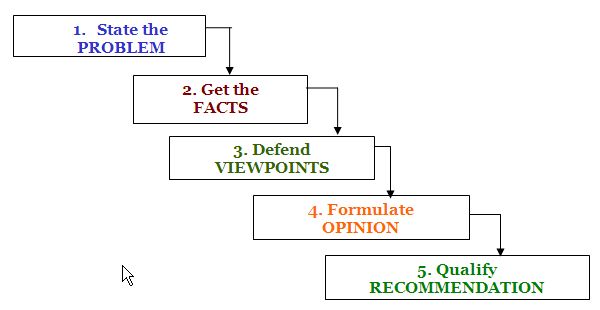
The problem solving model developed here involves five steps. It is a systematic approach to moral deliberation that is designed for groups of individuals, but can be used by individuals with some minor adjustments. This figure illustrates the steps of this model.

1. State the Problem 
  • Clearly define exact nature of ethical problem or dilemma. 
  • Need to be clear so that we can anticipate the kind of solution that is required. 
  • Want to provide an answer that is relevant to the interests at stake. 

2. Get the Facts 
  • Want to make an informed decision. 
  • Must possess and understand the relevant facts. 
  • Must make clear any interpretations of factual matters or the values than underlie conflicting moral viewpoints.

3. Identify & Defend Competing Moral Viewpoints
  • Critically assess the strengths and weaknesses of competing moral viewpoints. 
  • Begin by identifying what we believe to be the most compelling reason for the course of action. 
  • We must be able to justify the course of action. 

4. Formulate Opinions
  • As engineers we do not have the luxury of postponing questions or leaving a question unresolved. 
  • Decide which of the compelling viewpoints is the most compelling. 
  • The committee approach (voting) is advantageous because the decision is representative of the general public. 

5. Qualify Recommendations
  • Committees must qualify the recommendations they make by describing the level of consensus that was received. 
  • Should include the voting distribution and any dissenting opinions. 

The strategy described above is rather a formal process that would be followed in detail only for very complex cases. However, this strategy may be useful when a professional is stuck for a solution to a simpler problem.

In these circumstances, it is reassuring to know that many of the well-known methods of engineering – problem solving, generation of creative ideas, and decision making – can be applied to solve ethical problems as well.


References:
(1) “Complete Guide to Ethics Management: An Ethics Toolkit for Managers” - Written by Carter McNamara, MBA, PhD, Authenticity Consulting, LLC. Copyright 1997-2008.
(2) http://www.ethicsweb.ca/
(3) Moral Leadership
(4) “What Every Engineer Should Know About Ethics” Witten by Kenneth K. Humphreys
(5) http://www.ethicscasediscussions.org/

How to Apply an Engineering Method to Solve Ethical Problems (2)

What is ethics?

Some people will say "Ethics is simply to do what's right" or saying just “do good”. This myth was explained to me by one of the founder members of the Association of Romanian Engineers in Canada and during the last years I had to discuss and exemplify it with many newcomer engineers from Romania.

Ethics involves learning what is right or wrong, and then doing the right thing -- but "the right thing" is not nearly as straightforward as conveyed.

Some times many engineers may believe ethics is irrelevant because in business we cannot talk of ethics and training in ethics may avoid the real-to-life complexities in leading organizations.

We may consider ethics to be the "Science of Conduct.” Ethics includes the fundamental ground rules by which we live our lives. Philosophers such as Socrates and Plato have given guidelines for ethical behaviour.

Definition of Ethics

Ethics – the study of right and wrong, good and evil, obligations and rights, justice, and social and political ideas – is one of the four branches of philosophy, according to The Canadian Encyclopedia Plus.

The concept has come to mean various things to various people, but generally in the context of organizations coming to know what is right or wrong in the workplace and doing what's right -- this is in regard to effects of products/services and in relationships with stakeholders.

Leaders help to set the tone, develop the vision, and shape the behaviour of all those involved in organizational life.

“The critical point to understand here is that, like it or not, business and politics serve as the metronome for our society. And the meter and behavior established by leaders set the patterns and establish the models for our behavior as individuals and as a group. Although the terms "business ethics" and "moral leadership" are technically distinguishable, in fact, they are inseparable components in the life of every organization.” (1)

As a student of business ethics, I am convinced that without the continuous commitment, enforcement, and modeling of leadership, standards of business ethics cannot be achieved in any organization.

Friday, February 11, 2011

News You Can Use - "Welcome to Ontario" goes mobile

The Ministry of Citizenship and Immigration of the Government of Ontario launched the mobile version of the popular “Welcome to Ontario” newcomer guide for smartphones. You can check it out at ontario.ca/welcomeguide

The mobile version includes a link to “Settlement.Org. The original “Welcome to Ontario” booklet is available in PDF in 17 languages on our main website.


Additional Information:  http://ontario.ca/welcomeguide 

Friday, January 28, 2011

"Toronto's Many Faces" 5th edition - a sourcebook for newcomers

Toronto is truly a city of communities. Designed for tourists and for residents, "Toronto's Many Faces" is the one and only guide to the multicultural character of the city, featuring profiles of more than 60 ethnic communities, including local histories, festivals, food, and art. The book identifies each community - where its people come from, why, when, and where they settled in Toronto. The contribution of each community is also traced, with biographical notes on prominent people whose achievements have been extraordinary. Monuments, memorials, theatres, museums, cultural centres, and restaurants are identified, while detailed maps and photographs of festival events help bring the city's varied communities to life.

"Toronto's Many Faces is a guide for tourists, a sourcebook for newcomers, a directory for businesses and "organizations, and a passport for Torontonians to the many cultures that exist at their doorsteps.

For more details about the author Tony Ruprecht, MPP-Davenport click here.

Monday, January 10, 2011

Finish to Start!

A new year... a new start. You have some new/old goals, and everything depends on what YOU want! Recently, I've got this inspiration message from Joe Nunziata, which I'm sharing with you below:


"Many people are great starters and poor finishers. Why do so many people get excited in the beginning of their quest only to run out of steam in short period of time?

There are a number of reasons for the fade out. The main one is a lot external excitement and not enough intestinal fortitude. Talk is cheap and we love to talk about what we are going to do.

To finish you must have the internal energy, desire, belief and patience. When you have all of these attributes your chances of making it to the finish line are greatly improved. We all start things and fail to reach our goal. When you begin your next quest be sure you intent to finish what you start."


Here's Your START to FINISH roadmap. Take it and enjoy the journey!


Engineer Your Success In Canada


"The Journey. I've heard the saying: There's only two big decisions in life, where you're going, and who you're going to take with you. I know where I am going. I know who I am taking. I hope you do, too." ~ Jeffrey Gitomer - Little Black Book of Connections: 6.5 Assets for Networking Your Way to Rich Relationships