Showing posts with label skills. Show all posts

Thursday, February 25, 2016

The Engineering Community in Canada and The Power of Networking


Q: How about forming strong and professional relationships with people in your field or potential clients? Does this contribute to your success?

A: I would say that we all are in sales! Selling is a game. Life is a game. Both have their rules… and attitude is everything! The key to success is handling failure. A strong positive attitude is one of the most important traits, not only for a sales professional, but for everyone who wants to build strong relationships and succeed in any undertaking! Not always is easy to keep a positive attitude, but whatever you focus on becomes your reality, believe it or not. AREC’s purpose is to help you make better use of your professional network and help the people you trust in return. Improve your performance with the guidance of peers and mentors who’ll help you stretch and achieve your full potential. Be part of something bigger than yourself. “Let’s Connect and Build Relationships” is one of our objectives.
Speaking of AREC’s successes, an important part of that is because of our sponsors and partners, and I’d like to thank them again for their continuous support.  Some of them were with us from the beginning, others have joined us recently, and we at AREC appreciate you all!
Imagine that you have access to a pool of thousands of highly skilled internationally trained engineers from a wide array of expertise, qualified to match your business needs (such as recruitment or tapping in diverse markets)… this is AREC! (www.arec.ca)


Read more...
http://besocialevents.ca/creating-a-non-profit-organization-the-power-of-networking/

Monday, November 4, 2013

How to Create Your Ideal Career by Keith Rosen

Are you truly happy and fulfilled in your career? Do you wake up with a sense of excitement when heading off to work? Are you making the money and the impact you want to make at work and with your customers, given your experience, skills and talents? If not, maybe it’s time to reinvent your career path and actually design your ideal career. Yes, it is possible because dreams don’t have a shelf life. - read more here

Wednesday, August 21, 2013

Online resources help develop career plans by Sheryl Smolkin

The basic building blocks of a career plan are an inventory of your skills, abilities and the activities that you enjoy.

When you need money to pay the rent, it is often necessary to take the first job that comes along, even if it is not ideal. However, if you don’t have a career plan, several years later you may find yourself in the same dead end position.
The basic building blocks of a career plan are an inventory of your skills, abilities and the activities that you enjoy. Then you need to research the kinds of careers that are consistent with your aptitude and any further education or training you may need to qualify for the career you have chosen.
Most college and universities have career centres that offer counseling and resources to graduates and alumni. The websites below can also help.
Read more here.

Wednesday, July 17, 2013

Never Let a Job Description Talk You Out of That Job by Sam

Nothing to lose– Everything to gain – A great job to get:
Everyone has looked at countless job descriptions in their lifetime – let’s face it, even if you’re not even remotely considering a career move – happy, happy, happy in your job right now, chances are you have been direct recruited in the last six months or so (more than once I am sure) – by someone pitching you on the most fantabulous job with the most wonderful company with the best growth opportunity. Just start by looking at the job description……On the flip side, recruiters looking to hire have to weed through mountains of resumes – the good, the bad and the totally unqualified. Resumes and job descriptions are the international currency of the talent business. Believe you me if we took either of them at absolute face value, we would all be in trouble because so, so much is missed in the in the written word, lost without the cultural and passionate nuances and missed in the simple black and white translation.
Any successful first call between a qualified candidate and a Recruiter tends to end with the candidate wanting to see a job description before moving forward to a potential next step. And that’s certainly fair game. Why wouldn’t one want to see whether the nitty-gritty of a job is really of interest. But here’s the rub, don’t let a (potentially poorly or incomplete) written job description possibly remove you from pursuing a potential role before you really understand the full story.
Read more here.

Friday, September 28, 2012

Business Edge for Internationally Educated Professionals


Business Edge is for internationally educated men and women who are building careers in Canada. It helps you build professional confidence and acquire the relevant business skills you need to advance your career. The program will help you understand the subtleties of the Canadian workplace and learn new strategies for success.


We are now accepting applications for the fall offering of the program that starts on November 10th, 2012.  
Sabina Michael
Program Manager

Rotman School of Management
University of Toronto
105 St. George Street
Toronto, ON M5S 3E6
Tel: 416.978.7059
Fax: 416.978.5549

www.rotmanexecutive.com/businessedge

AREC link.

Wednesday, August 15, 2012

Newcomers face unique job search challenges By Kyla Frankowski


This is the fourth part in a series of columns to offer job search tips and advice, written by Lutherwood staff. Lutherwood is a local agency that offers employment support as well as a range of other services which are accessed by more than 20,000 people annually in Waterloo Region and Wellington County.
Newcomers to Canada often face many challenges when looking for work that fits their past experience.
These challenges can include differing work environments, qualification requirements and workplace cultures, as well as a lack of a social network.
However, there are some basic steps you can take to ensure you are on the right track.
If you are new to Canada and looking for work, you need to know how your skills and previous occupation fit into the Canadian labour market. So your first step is to find out which Canadian occupation best matches your experience and skills.
Recently, I worked with an individual who held the title of electrical engineer in his native country.
But when we reviewed his skills and work experience, we discovered that he better matched the occupation of industrial millwright here in Canada. Knowing this, we were able to focus his job search efforts.
The second step is to learn what skills and experience Canadian employers are looking for, review your own skills and experience, and identify any gaps.
To determine Canadian employers’ needs, you should review job postings, talk to employers and talk to people working in your field.
Ideally, you should try and connect with someone who has been successful getting work in your profession so that you can learn what worked or didn’t work for them.
Now that you know what type of job you are looking for and any skill and experience gaps you need to fill, the third step is to create a plan to fill those gaps.
There are many options for upgrading skills and increasing experience, including programs designed specifically for newcomers to Canada. These options include mentoring with someone working in your field, accessing apprenticeship opportunities and enrolling in English-language or job-skill upgrading courses.
Once the gaps are filled, you are in a position to work on your resumé, prepare yourself for interviews and find employers who are hiring in your field.
Finally, build a network. Finding work in today’s economy is difficult enough without trying to do it on your own. A network is a group of people who know you, know what kind of work you are looking for and will help you.
Try to include people who have successfully adapted to the Canadian workplace and culture as well as people working in your field and industry of interest. Find out what job opportunities they know about and who they know that can help you with your job search.
I strongly advise speaking with someone at a local government-funded employment services agency.
Employment advisors can help you focus your job search, identify skill and experience gaps, help you access employment programs, identify training and financial assistance opportunities such as Second Career, and give you guidance on preparing for your job search.
Adapting your professional skills and experience to fit within a new country is challenging.
But with a bit of time, dedication and support, you may be surprised at how quickly you can find the work you are looking for.
• • •
Kyla Frankowski, an employment advisor at Lutherwood, has more than eight years of experience offering employment services. She works primarily with newcomers to Canadain the Job Search Workshop program. For more information, visit www.lutherwood.ca/employment.

Wednesday, July 25, 2012

The Lead Wolf Model of Leadership


Surviving the Narcissist Leader By Dr. Rick Johnson

CEOs or Presidents, who attain positions of power, reach these positions for a variety of reasons. The reasons are not always a result of competency and hard work; these positions are not always earned. As a result employees find themselves under the rule of various kinds of leaders. Even those leaders that have earned their position can be impossible to work for and it’s difficult to be happy and satisfied doing it. I was once asked to write an article for a magazine about the old style of autocratic leadership that was so effective in the 70’s and even the 80’s. I titled it B.O.S.S. this stood for Boisterous, Omnipotent, Self-Indulgent, Scumbag but the magazine made me change the last S to Sociopath.

I used to work for a B.O.S.S. He was always walking around muttering “I’m the BOSS – you’re nothing. I’m the BOSS you’re nothing.” I wanted to say, “Well, whoopee, you’re the BOSS of nothing.”

Presidents and CEOs are typically seen as sources of motivation and direction. But what's often overlooked is the fact that they not only motivate their management team but they receive motivation and even direction based on the responses from the employees below them.

What type of leader do you work for?

The Lead Wolf (servant) style of leadership is successful because these leaders take the time to listen, imagine and investigate numerous alternatives. With the involvement of people they forge creative solutions to difficult problems. They challenge their people to stretch, go beyond their previous boundaries and think outside the box. 

Successful leaders feed off their people and allow their people to feed off of them. They give credit where credit is due. They give recognition as a means of gaining respect. They believe individuals can make a difference. Through these methods they learn to create new insights and possibilities. Successful leadership means creating a sense of urgency, getting mutual commitment to action. Action steps are always clearly defined and precise.

The Lone Wolf (BOSS - Autocratic) leader at the top dominates with power. They are autocratic and intimidating. They often believe that employees are a necessary inconvenience and aren’t capable of creativity and innovation.  More often than not, they embrace the “seat of the pants” based on intuitive judgment leadership style. This allows them maximum flexibility and “shoot from the hip responsiveness.” However, today’s environment demands a more stable administrative structure that requires a change in the nature of past leadership practices. Simply put, it’s an evolution from a highly reactive, autocratic individualistic style to a more empowering, employee oriented proactive style.

It’s about going from a “Lone Wolf” leadership style to a “Lead Wolf” leadership style that has confidence in the employee’s ability to make things happen and empowers the employees to get the job done.

What about the Narcissist Leader?
            
The Narcissist leader is often very successful. In fact there may be a certain amount of narcissism in all of us. However, the narcissism that exists must be balanced with respect in our relationship with our employees. Excessive narcissism from a psychological standpoint is considered a personality disorder. 
I personally have worked for two Narcissist CEOs during my career. Both of them were extremely vain, egotistical, conceited, selfish and paranoid. Each demonstrated one or more of those character flaws to an extreme. One actually threw a stapler at his secretary. Another had bugging devices installed in his executive team’s offices.

How Do I Survive in a Narcissist Environment?

Managing your BOSS requires skill. Intelligence alone isn’t enough. It requires leadership skill on your part. Excellent communication skills are a prerequisite and self-confidence in your own ability is a must to support your actions. Delivering excellent results for every assignment will not only gain their confidence but can actually create a dependence on their part. They will come to rely on you to make them look good.

Continue to make suggestions, express ideas that support the CEO’s personal initiatives that will bring them success and credit. This is especially helpful if they can gain the credit while you take the risk. Allow the CEO to take credit for your ideas and shoulder the blame for those that don’t work out. Is this risky? Sure it is but if you want to survive or even thrive under a narcissist it’s a risk worth taking. Of course, you could also just walk but that option isn’t always practical.

Understand the Narcissist Ego

Managing or just surviving a Narcissist BOSS is difficult at best. Building a relationship with a Lone Wolf or Narcissist CEO is based upon an understanding of and a capacity to manage the narcissism of the CEO.  This means you must establish a balance between expressing your opinions; ideas and candid remarks while utilizing your knowledge of the CEO’s need to maintain his acknowledge position of power in the organization. A narcissist CEO and some Lone Wolf CEOs have an inflated sense of self. They openly demonstrate their feelings of superiority, entitlement (especially in family run businesses) and an insatiable need for attention and admiration.

Manage Your Risk

Narcissist CEOs often trust very few people. As a result they may allow their spouse to become extremely influential with regard to their leadership style. Some may even employ their spouse in the workplace. Their creation of this spousal influence and dependence can be risky for you. One Narcissist CEO I worked for was single but used his girlfriend who was employed as my administrative assistant to fill this role. The risk lies not only in trying to manage that relationship if they are also employed at the company but this dependence and influence can actually isolate the CEO from his executive team because this influence generally will support his grandiose ideas. Additionally they feed his paranoia. Be conscious at all times of the following character traits:
  • All employees are expected to think the way he/she does.
  • Their strategies are often dynamic but grandiose.
  • They trust only their own insights.
  • They can be charming, glib, accommodating but often are manipulative, deceitful, ruthless and destructive.
Are Narcissist Leaders Successful?

Just as Lone Wolf autocratic leaders were very successful in the seventies and eighties many narcissist leaders can be very effective. In fact some very famous leaders are considered narcissists by some. People like Jack Welsch of General Electric, Bill Gates of Microsoft and Steve Jobs of Apple to name a few. These three CEOs are all very successful; however, they may be the exception to the rule. Look at Enron and World Com. These two companies weren’t just aberrations. Personally, I believe they represent what can happen when ineffective leadership driven by narcissism creates a cancer at the top that becomes malignant and begins to filter throughout the management regime.

These leaders and many others were undeservedly worshiped when the perception of success and enormous profits disguised their real character traits and leadership model. Profit covers many sins including the sins of the CEO. It allows us to ignore physiological brainwashing, manipulation, con artistry, exploitation and abusive behavior. They are extremely insensitive to respect for employees.

There are numerous narcissist CEOs at the helm of many corporations today. The challenge of ownership, first generation founders and executive teams reporting to these CEOs is to insure that these leaders don’t self-destruct and lead the company into a death spiral. This becomes an extremely difficult task for all involved because a true narcissist doesn’t even understand their own issues let alone the willingness to work through them. Narcissists need professional counseling to help them accept reality and recognize their limitations. Their extreme independence, paranoia and self-preservation create a wall that takes a bunker busting bomb to break through.

The Lead Wolf Model of Leadership

Effective leaders must have an edge. They must be courageous enough to take risk and have an unrelenting readiness to act. Popularity is not a requirement, but the ability to generate respect from the employees is, without a doubt, one of the most critical attributes. They must be relentless in their efforts, unconcerned about personal sacrifice of their time, and willing to go beyond normal expectations. Tough decisions are commonplace; uncharted territories will be the norm. Honesty and impeccable character are musts.

Lead Wolf leaders take charge and are not afraid of responsibility or risk. Most people want to follow them. A good leader develops openness, honesty, clarity of purpose and a sincere caring for the people they lead. They gain commitment and trust by demonstrating respect for the individual. They have a keen sense of understanding. They believe in their task, they understand the objectives, they communicate clearly and they honestly project the understanding that they need the efforts of everyone to succeed. That’s the Lead Wolf model of leadership. It’s all about believing in employees and their ability to create success. 

E-mail rick@ceostrategist.com for the Lead Wolf leadership thought provoker checklist and sign up for The Howl leadership newsletter at www.ceostrategist.com.
.
www.ceostrategist.com – Sign up to receive “The Howl” a free* monthly newsletter and get your choice of "CEO Strategist's Hiring and Interview Guide" or "The Guide to Effective Training Sessions", valuable resources for all levels of management. The Howl addresses real world industry issues. – Straight talk about today’s issues.  Rick Johnson, expert speaker, wholesale distribution’s “Leadership Strategist”, founder of CEO Strategist, LLC a firm that helps clients create and maintain competitive advantage. Need a speaker for your next event, E-mail rick@ceostrategist.com.

Saturday, February 26, 2011

How to Apply an Engineering Method to Solve Ethical Problems (3)


An Engineering Strategy for Solving Complex Ethical Problems

Everyday life ethical issues are clear and simple and solved by intuitive use of ethical theories. Complex ethical problems can be more challenging.

Various types of professionals, including engineers, often express significant differences of opinion when faced with cases requiring an ethical solution. Engineers should have an advantage in resolving ethical dilemmas, since problem-solving and decision making techniques are a routine part of engineering.

Being an engineer, I’d like to provide a framework for reconciling differences of opinion as we address the question, “what is the right thing to do?” in circumstances involving ethical issues in the engineering profession.

The problem solving method developed here is from the book What Every Engineer Should Know About Ethics, by Kenneth K. Humphreys (4)

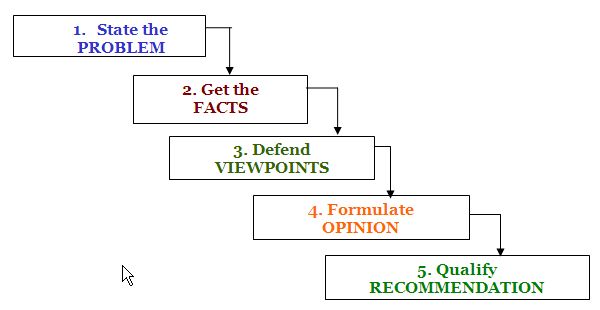
The problem solving model developed here involves five steps. It is a systematic approach to moral deliberation that is designed for groups of individuals, but can be used by individuals with some minor adjustments. This figure illustrates the steps of this model.

1. State the Problem 
  • Clearly define exact nature of ethical problem or dilemma. 
  • Need to be clear so that we can anticipate the kind of solution that is required. 
  • Want to provide an answer that is relevant to the interests at stake. 

2. Get the Facts 
  • Want to make an informed decision. 
  • Must possess and understand the relevant facts. 
  • Must make clear any interpretations of factual matters or the values than underlie conflicting moral viewpoints.

3. Identify & Defend Competing Moral Viewpoints
  • Critically assess the strengths and weaknesses of competing moral viewpoints. 
  • Begin by identifying what we believe to be the most compelling reason for the course of action. 
  • We must be able to justify the course of action. 

4. Formulate Opinions
  • As engineers we do not have the luxury of postponing questions or leaving a question unresolved. 
  • Decide which of the compelling viewpoints is the most compelling. 
  • The committee approach (voting) is advantageous because the decision is representative of the general public. 

5. Qualify Recommendations
  • Committees must qualify the recommendations they make by describing the level of consensus that was received. 
  • Should include the voting distribution and any dissenting opinions. 

The strategy described above is rather a formal process that would be followed in detail only for very complex cases. However, this strategy may be useful when a professional is stuck for a solution to a simpler problem.

In these circumstances, it is reassuring to know that many of the well-known methods of engineering – problem solving, generation of creative ideas, and decision making – can be applied to solve ethical problems as well.


References:
(1) “Complete Guide to Ethics Management: An Ethics Toolkit for Managers” - Written by Carter McNamara, MBA, PhD, Authenticity Consulting, LLC. Copyright 1997-2008.
(2) http://www.ethicsweb.ca/
(3) Moral Leadership
(4) “What Every Engineer Should Know About Ethics” Witten by Kenneth K. Humphreys
(5) http://www.ethicscasediscussions.org/

Sunday, October 3, 2010

Communication X 3!

Last week I participated at a presentation organized by the Association of Romanian Engineers in Canada. The topic was "Understanding Project Management", and the presenter Mr. Rishi Kumar. P.Eng., PMP, CMC was very eloquent in pointing out that the most important factor in the success or failure of a project is Communication. Based on his experience, the interpersonal skills, contracting and negotiation skills are playing the biggest role.


Communication, communication and more communication! Is communication used only in project management? Of course, not! However, everything is project management, as well as everything is... negotiation, as well as we all are in sales! Even if you think you're not :). 
We are first and foremost social beings. And most on the conversations in the workplace are social. Hi, how are you? How was your weekend? How was in vacation? How is your son? etc.
Great social interaction prepares the platform on which work is built. 
So, how we can get better?


Here are a few initial steps ideas:
1. Before coming to Canada improve your English speaking skills.
 - Test Your English
- Learn Business English
- 11 RULES OF WRITING
2. Once you're here, join a Toastmasters International club.
 - Why to join? Read this and then go Find Meeting Locations near to your area.
3. Use different resources like these:
 - FREE Communispond Podcast Library
 - Communication skills


...and be prepared for more. 
Enjoy and be happy now!


"The formulation of the problem is often more essential than its solution." ~ Albert Einstein

Tuesday, August 24, 2010

Five Simple Rules by Mircea Mihaescu

One of the "advantages" of working for a number of years is that you develop a small set of rules you apply to many (if not most...) of the situations you encounter. The way you have those guidelines applied varies from project to project, however you need a way to make them known to the people you work with in a simple way. I try to make mine "memorable" as well... here are five of them, that many of my colleagues have heard me repeating often:

1. If things seem under control, you are not driving fast enough (from Mario Andretti, race car driver)


This is my all-time favorite, as it describes a philosophy of pushing to your (or your team's) limits. If you don't try, you'll never know what you are capable of...


2. If it's too steep, you are too old (from a T-shirt in Banff, a ski town in Western Canada)
A corollary of the previous one, it is emphasizing the need to stay young at heart, to search for new ideas and and new ground, to "boldly go..." (you know the rest).


3. How many years does it take to get 15 years of experience? (from me)


My point is that in many professional domains it just takes time and effort to achieve the required level of proficiency. The answer is, of course, "approximately 15 years", and it should not be considered a "put down" message, rather as encouraging people to set goals and work hard to achieve them. No one wants to be operated on by a surgeon working for a clinic that advertises hiring with "no experience required"... Recently, Malcolm Gladwell has written extensively about this in his book "Outliers".


4. I've never heard such a stupid idea in my whole life! (one of my former managers)


The point here is to think and try to understand new ideas thoroughly, be constructive and tactful with your feedback. The manager in the story made that comment when hearing a suggestion from the company's CEO ( I was there as a techie). He was fired that evening. And the idea did fail spectacularly...


5. You need to repeat something seven times for an adult to remember (from personal experience)


One of my friends is a kindergarten teacher. She told me she doesn't stop from being amazed how quickly kids pick things up and remember them days after the initial discussion. It looks like after so many years of school, we adults have developed a certain level of resistance to other people speaking. So now I do not get frustrated, I just say it again, and again, and again...


Read more of Mircea at Thoughts on entrepreneurship, innovation and software development.


"The illiterate of the 21st Century will not be those who cannot read and write, but those who cannot learn, unlearn, and relearn." ~ Alvin Toffler

Monday, August 16, 2010

News You Can Use - A path to acceptance for immigrant professionals

“Obviously I want to find something more permanent that uses my skills,” he says, such as a job as project co-ordinator or sales or technology manager. But to do that he’s realized he has to reinvent himself for the realities of the Canadian workplace. - THE GLOBE AND MAIL


Read the article here.

Sunday, August 15, 2010

The Eighth Quality: They are Excellent Communicators

They get their message across – even though they may not always speak perfect English. 
They are fully involved in the conversation. 
They listen. 
They demonstrate their commitment. 
They show their enthusiasm. 
They engage the people around them.
Now, please take your time and go through these next five steps. Be clear and specific.
  1. How are you improving your communication skills – speaking, writing, listening?
    • Identify what you need to do to become a great communicator. 
  2. What’s your communication style... and how can you improve?
    • Decide what it is your style.
    • Do you know the four phases of the communication process?
      • 1. Verbal or Non-verbal
      • 2. Meaning or Perception
      • 3. Clarifying
      • 4. Shared Meaning & Understanding
    • Are you practicing it?
  3. Are you demonstrating your enthusiasm and commitment effectively?
    • Remember... "It's not what you say or do, but HOW you say it." 
  4. How can you motivate people to want to speak with you?
    • Are you a good listener? What steps do you need to take to improve your listening skills?
      • “Try honestly to see things from the other person's point of view." ~ Dale Carnegie
        • Think of LADDER to be a good listener
          • Look at the other person. 
          • Ask questions. 
          • Don't interrupt. 
          • Don't change the subject. 
          • Express emotion with control. 
          • Respond appropriately.
    • What are your keys to success?
      • Hear & Understand - Focus on what is being said!
      • Expect the Best When Communicating - Be Optimistic!
      • Act with Integrity in All Your Interactions - Be Honest & Fair!
      • Respect Diversity and Recognize Differences - Build Rapport!
  5. Are you web-smart?
    • Are you on LinkedIn? Connect to get the opportunity! Help others!!
"Communication is defined as consisting of 7-10% words, 35% tone and 55% non verbal." ~ Albert Mehrabian
"Debunking the 55%, 38%, 7% Rule" ~ Judith E. Pearson