The Gateway, York Region's first conference for internationally educated professionals (IEPs), provides an opportunity for IEPs, newcomer entrepreneurs, employers, professional associations and government representatives to make new contacts, exchange ideas and learn from each other.
Fore more details check here.
Showing posts with label professional. Show all posts
Showing posts with label professional. Show all posts
Thursday, October 18, 2012


Wednesday, August 15, 2012
Newcomers face unique job search challenges By Kyla Frankowski
This is the fourth part in a series of columns to offer job search tips and advice, written by Lutherwood staff. Lutherwood is a local agency that offers employment support as well as a range of other services which are accessed by more than 20,000 people annually in Waterloo Region and Wellington County.
Newcomers to Canada often face many challenges when looking for work that fits their past experience.
These challenges can include differing work environments, qualification requirements and workplace cultures, as well as a lack of a social network.
However, there are some basic steps you can take to ensure you are on the right track.
If you are new to Canada and looking for work, you need to know how your skills and previous occupation fit into the Canadian labour market. So your first step is to find out which Canadian occupation best matches your experience and skills.
Recently, I worked with an individual who held the title of electrical engineer in his native country.
But when we reviewed his skills and work experience, we discovered that he better matched the occupation of industrial millwright here in Canada. Knowing this, we were able to focus his job search efforts.
The second step is to learn what skills and experience Canadian employers are looking for, review your own skills and experience, and identify any gaps.
To determine Canadian employers’ needs, you should review job postings, talk to employers and talk to people working in your field.
Ideally, you should try and connect with someone who has been successful getting work in your profession so that you can learn what worked or didn’t work for them.
Now that you know what type of job you are looking for and any skill and experience gaps you need to fill, the third step is to create a plan to fill those gaps.
There are many options for upgrading skills and increasing experience, including programs designed specifically for newcomers to Canada. These options include mentoring with someone working in your field, accessing apprenticeship opportunities and enrolling in English-language or job-skill upgrading courses.
Once the gaps are filled, you are in a position to work on your resumé, prepare yourself for interviews and find employers who are hiring in your field.
Finally, build a network. Finding work in today’s economy is difficult enough without trying to do it on your own. A network is a group of people who know you, know what kind of work you are looking for and will help you.
Try to include people who have successfully adapted to the Canadian workplace and culture as well as people working in your field and industry of interest. Find out what job opportunities they know about and who they know that can help you with your job search.
I strongly advise speaking with someone at a local government-funded employment services agency.
Employment advisors can help you focus your job search, identify skill and experience gaps, help you access employment programs, identify training and financial assistance opportunities such as Second Career, and give you guidance on preparing for your job search.
Adapting your professional skills and experience to fit within a new country is challenging.
But with a bit of time, dedication and support, you may be surprised at how quickly you can find the work you are looking for.
• • •
Kyla Frankowski, an employment advisor at Lutherwood, has more than eight years of experience offering employment services. She works primarily with newcomers to Canadain the Job Search Workshop program. For more information, visit www.lutherwood.ca/employment.
Thursday, March 1, 2012
Become a Change-Master!
If you remember, one of the qualities of the IEPs is that they are Change-Masters; The Sixth Quality: They Are Change-Masters
Herewith McGhee Productivity Solutions is sharing this productivity tip that will help you overcome the most common of your limiting beliefs and become more efficient and productive.
Back to Basics: 10 Beliefs
That Limit Productivity
When
clients start to make positive changes toward improving their productivity,
they often bump up against their unconscious limiting beliefs and find making
the changes hard. Therefore, it is a good idea to acknowledge the
limiting beliefs ahead of time so that you can begin the process of turning
them around (moving them from the ‘unconscious’ to the ‘conscious’).
Limiting beliefs, unconscious by nature, are usually buried beneath statements
with which most of us are familiar. We want to help you clarify yours by
offering 10 of the most common statements we hear from our clients and the
limiting beliefs that also accompany them. Then we will look under each
statement at a new belief and general solution to help you create and foster
increased productivity:
There’s too much information coming at me too fast, and I can’t keep up.
LIMITING BELIEF: I should be able to handle all the information that is coming at me
NEW BELIEF: There is a way to be in control of my email, and I can regularly have an empty Inbox
SOLUTIONS: The volume of email isn’t really the issue; how you process and organize the volume is. Learning how to use the “Four D’s for Decision Making” can transform this belief.
I get too many interruptions
LIMITING BELIEF: Interruptions are a necessary part of my day-to-day experience
NEW BELIEF: I create boundaries that allow me to manage interruptions successfully
SOLUTIONS: You can reduce the number of interruptions you receive and get your “real work” done during the day by implementing personal boundaries that allow you and your staff to create scheduled uninterrupted work time.
I don’t have the discipline to be organized
LIMITING BELIEF: I am an easygoing person – I’m not a disciplined person
NEW BELIEF: Discipline is a decision, not a personality trait, and therefore I can be organized and use a system effectively.
SOLUTIONS: Discipline is a skill that you already possess; you demonstrate it every day. The key to discipline is creating the appropriate motivation to make the specific changes you want. This enthusiasm then drives you to be disciplined.
I have to keep everything
LIMITING BELIEF: As soon as I get rid of it, you just know I’m going to need it
NEW BELIEF: I don’t need most of what I keep, and so I am letting go and trusting my new system in which the Delete key is my friend.
SOLUTIONS: OK, prepare yourself. On average, the clients we weork with throw away 50% of their stored information, and they feel lighter, happier, and have more time.
It takes too much time to get productive
LIMITING BELIEF: My job is more important than the effort it takes to implement a new system
NEW BELIEF: I’m happily investing in my system, and my productivity is increasing
SOLUTIONS: You can save one to two hours a day using an Integrated Management System. This fact alone more than justifies the upfront investment required to set it up.
I can’t find what I need when I need it
LIMITING BELIEF: My system doesn’t work and so I rely on my memory
NEW BELIEF: Reference systems are easy to set up and they save me time.
SOLUTIONS: Setting up a Reference System is a skill that anyone can learn, and it’s a skill that can save you 50 minutes a day.
Organization cramps my freedom and creativity
LIMITING BELIEF: It’s not possible to be creative and organized at the same time
NEW BELIEF: It is possible to be organized and spontaneous; in fact, organization promotes my experience of freedom and creativity.
SOLUTIONS: Organization actually fosters and supports creativity and spontaneity
I’m no good with technology
LIMITING BELIEF: Technology is hard to learn, and I’m not a technical person
NEW BELIEF: I can learn to use technology and it supports me in being productive and effective
SOLUTIONS: Using technology is a skill anyone can learn with the right education. You’ll be surprised at the personal satisfaction that comes from using technology more effectively.
There is not enough time in the day!
LIMITING BELIEF: I should be able to do everything I want to do in a day
NEW BELIEF: I can’t do everything, but by working effectively with my calendar, I can get the most important things done
SOLUTIONS: Lack of time is seldom the issue. The real issue is working in cooperation with your calendar and deciding on what you can do given the amount of time you have
I’m not organized by nature
LIMITING BELIEF: Organization is a gene that’s passed down the family line, but I didn’t get it!
NEW BELIEF: I can learn to be organized and have fun with it
SOLUTIONS: Organization is an exceptionally simple skill that you can learn just like any other. In fact, it’s a skill that’s easier to pick up than are most of the skills you learned in your current career!
Take some time to review areas where you are being productive and areas where you are encountering obstacles. Look at which one of these 10 Beliefs are most aligned with the problems you are encountering, and really practice letting go and taking on a new belief that supports your productivity. Sometimes, the basics are the easiest part of the system to forget, so refresh yourself regularly and maintain control and organization around your productivity.
There’s too much information coming at me too fast, and I can’t keep up.
LIMITING BELIEF: I should be able to handle all the information that is coming at me
NEW BELIEF: There is a way to be in control of my email, and I can regularly have an empty Inbox
SOLUTIONS: The volume of email isn’t really the issue; how you process and organize the volume is. Learning how to use the “Four D’s for Decision Making” can transform this belief.
I get too many interruptions
LIMITING BELIEF: Interruptions are a necessary part of my day-to-day experience
NEW BELIEF: I create boundaries that allow me to manage interruptions successfully
SOLUTIONS: You can reduce the number of interruptions you receive and get your “real work” done during the day by implementing personal boundaries that allow you and your staff to create scheduled uninterrupted work time.
I don’t have the discipline to be organized
LIMITING BELIEF: I am an easygoing person – I’m not a disciplined person
NEW BELIEF: Discipline is a decision, not a personality trait, and therefore I can be organized and use a system effectively.
SOLUTIONS: Discipline is a skill that you already possess; you demonstrate it every day. The key to discipline is creating the appropriate motivation to make the specific changes you want. This enthusiasm then drives you to be disciplined.
I have to keep everything
LIMITING BELIEF: As soon as I get rid of it, you just know I’m going to need it
NEW BELIEF: I don’t need most of what I keep, and so I am letting go and trusting my new system in which the Delete key is my friend.
SOLUTIONS: OK, prepare yourself. On average, the clients we weork with throw away 50% of their stored information, and they feel lighter, happier, and have more time.
It takes too much time to get productive
LIMITING BELIEF: My job is more important than the effort it takes to implement a new system
NEW BELIEF: I’m happily investing in my system, and my productivity is increasing
SOLUTIONS: You can save one to two hours a day using an Integrated Management System. This fact alone more than justifies the upfront investment required to set it up.
I can’t find what I need when I need it
LIMITING BELIEF: My system doesn’t work and so I rely on my memory
NEW BELIEF: Reference systems are easy to set up and they save me time.
SOLUTIONS: Setting up a Reference System is a skill that anyone can learn, and it’s a skill that can save you 50 minutes a day.
Organization cramps my freedom and creativity
LIMITING BELIEF: It’s not possible to be creative and organized at the same time
NEW BELIEF: It is possible to be organized and spontaneous; in fact, organization promotes my experience of freedom and creativity.
SOLUTIONS: Organization actually fosters and supports creativity and spontaneity
I’m no good with technology
LIMITING BELIEF: Technology is hard to learn, and I’m not a technical person
NEW BELIEF: I can learn to use technology and it supports me in being productive and effective
SOLUTIONS: Using technology is a skill anyone can learn with the right education. You’ll be surprised at the personal satisfaction that comes from using technology more effectively.
There is not enough time in the day!
LIMITING BELIEF: I should be able to do everything I want to do in a day
NEW BELIEF: I can’t do everything, but by working effectively with my calendar, I can get the most important things done
SOLUTIONS: Lack of time is seldom the issue. The real issue is working in cooperation with your calendar and deciding on what you can do given the amount of time you have
I’m not organized by nature
LIMITING BELIEF: Organization is a gene that’s passed down the family line, but I didn’t get it!
NEW BELIEF: I can learn to be organized and have fun with it
SOLUTIONS: Organization is an exceptionally simple skill that you can learn just like any other. In fact, it’s a skill that’s easier to pick up than are most of the skills you learned in your current career!
Take some time to review areas where you are being productive and areas where you are encountering obstacles. Look at which one of these 10 Beliefs are most aligned with the problems you are encountering, and really practice letting go and taking on a new belief that supports your productivity. Sometimes, the basics are the easiest part of the system to forget, so refresh yourself regularly and maintain control and organization around your productivity.
"Try not. Do or do not. There is not try." - Yoda
Saturday, February 26, 2011
How to Apply an Engineering Method to Solve Ethical Problems (3)
An Engineering Strategy for Solving Complex Ethical Problems
Everyday life ethical issues are clear and simple and solved by intuitive use of ethical theories. Complex ethical problems can be more challenging.
Various types of professionals, including engineers, often express significant differences of opinion when faced with cases requiring an ethical solution. Engineers should have an advantage in resolving ethical dilemmas, since problem-solving and decision making techniques are a routine part of engineering.
Being an engineer, I’d like to provide a framework for reconciling differences of opinion as we address the question, “what is the right thing to do?” in circumstances involving ethical issues in the engineering profession.
The problem solving method developed here is from the book What Every Engineer Should Know About Ethics, by Kenneth K. Humphreys (4)
The problem solving model developed here involves five steps. It is a systematic approach to moral deliberation that is designed for groups of individuals, but can be used by individuals with some minor adjustments. This figure illustrates the steps of this model.
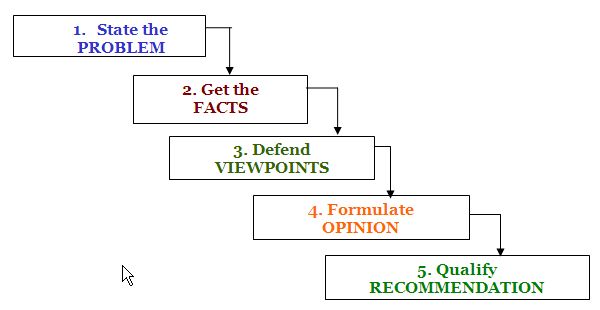
- Clearly define exact nature of ethical problem or dilemma.
- Need to be clear so that we can anticipate the kind of solution that is required.
- Want to provide an answer that is relevant to the interests at stake.
2. Get the Facts
- Want to make an informed decision.
- Must possess and understand the relevant facts.
- Must make clear any interpretations of factual matters or the values than underlie conflicting moral viewpoints.
3. Identify & Defend Competing Moral Viewpoints
- Critically assess the strengths and weaknesses of competing moral viewpoints.
- Begin by identifying what we believe to be the most compelling reason for the course of action.
- We must be able to justify the course of action.
4. Formulate Opinions
- As engineers we do not have the luxury of postponing questions or leaving a question unresolved.
- Decide which of the compelling viewpoints is the most compelling.
- The committee approach (voting) is advantageous because the decision is representative of the general public.
5. Qualify Recommendations
- Committees must qualify the recommendations they make by describing the level of consensus that was received.
- Should include the voting distribution and any dissenting opinions.
The strategy described above is rather a formal process that would be followed in detail only for very complex cases. However, this strategy may be useful when a professional is stuck for a solution to a simpler problem.
In these circumstances, it is reassuring to know that many of the well-known methods of engineering – problem solving, generation of creative ideas, and decision making – can be applied to solve ethical problems as well.
References:
(1) “Complete Guide to Ethics Management: An Ethics Toolkit for Managers” - Written by Carter McNamara, MBA, PhD, Authenticity Consulting, LLC. Copyright 1997-2008.
(2) http://www.ethicsweb.ca/
(3) Moral Leadership
(4) “What Every Engineer Should Know About Ethics” Witten by Kenneth K. Humphreys
(5) http://www.ethicscasediscussions.org/
Wednesday, September 8, 2010
Today is Gateway Day by Mike Lipkin

» Watch the video
» Listen to the podcast
» Read Mike’s new insights
Monday, September 6, 2010
What you focusing on?

Each week I will select one or more topics related to the exercises proposed under each main quality of our topic and share with you some experiences about the way that my friends or myself went through something like this.
Just goggle "achieve balance" and you will get millions of hits. We hear a lot about the need of balance in our lives, between work and personal life, etc. On many sites you will get recipes about how to achieve it. Personally, I believe that maintaining balance in our daily life is impossible. I can agree with the concept of ecological balance in nature - as a whole, however I like to see it from the perspective of energy. Energy is always moving based on our focus. So, where are you moving your energy? It is your work? It is your family? By changing your focus, you enable an instant change in how you feel, you can change your emotional state. Are you stressed? If you are stressed, then this is a result of where you're putting your focus.
Remember: Whatever you focus on becomes your reality! (Believe it or not!) In fact, everything you do is a reflection of what you are focusing on... in your career, in your personal life and relationships or in your health. What you focus on determines how you'll feel!
Now, write down why you must Engineer Your Success in Canada, even if you are not an engineer. As my friend Salvador put it, "These top ten qualities to be successful are fundamental for any professional trying to succeed in this new interconnected world."
Now, please take your time and go through these next five steps. Be clear and specific. One step at a time...
P.S. Do you notice any strange wording? (hint: see title)
"Quality questions create a quality life." ~ Anthony Robbins
"Always I will take another step. If that is of no avail I will take another, and yet another. In truth, one step at a time is not too difficult.” ~ Og Mandino
Remember: Whatever you focus on becomes your reality! (Believe it or not!) In fact, everything you do is a reflection of what you are focusing on... in your career, in your personal life and relationships or in your health. What you focus on determines how you'll feel!
Now, write down why you must Engineer Your Success in Canada, even if you are not an engineer. As my friend Salvador put it, "These top ten qualities to be successful are fundamental for any professional trying to succeed in this new interconnected world."
Now, please take your time and go through these next five steps. Be clear and specific. One step at a time...
- What are your reasons?
- What will it give you, your family, and your friends?
- What will it eliminate?
- What kind of stress would disappear if you had a guide like this?
- Write down what it will cost you if you don't take the time to master all these qualities.
P.S. Do you notice any strange wording? (hint: see title)
"Quality questions create a quality life." ~ Anthony Robbins
"Always I will take another step. If that is of no avail I will take another, and yet another. In truth, one step at a time is not too difficult.” ~ Og Mandino
Tuesday, August 31, 2010
News You Can Use - The power of a simple ‘thank you’

"Think about this: When was the last time you wrote or received a handwritten note of thanks or even a thank-you e-mail?" read more...
“Make it a habit to tell people thank you. To express your appreciation, sincerely and without the expectation of anything in return. Truly appreciate those around you, and you’ll soon find many others around you. Truly appreciate life, and you’ll find that you have more of it.” ~ Ralph Marston
Tuesday, August 24, 2010
Five Simple Rules by Mircea Mihaescu
One of the "advantages" of working for a number of years is that you develop a small set of rules you apply to many (if not most...) of the situations you encounter. The way you have those guidelines applied varies from project to project, however you need a way to make them known to the people you work with in a simple way. I try to make mine "memorable" as well... here are five of them, that many of my colleagues have heard me repeating often:
1. If things seem under control, you are not driving fast enough (from Mario Andretti, race car driver)
This is my all-time favorite, as it describes a philosophy of pushing to your (or your team's) limits. If you don't try, you'll never know what you are capable of...
2. If it's too steep, you are too old (from a T-shirt in Banff, a ski town in Western Canada)
A corollary of the previous one, it is emphasizing the need to stay young at heart, to search for new ideas and and new ground, to "boldly go..." (you know the rest).
3. How many years does it take to get 15 years of experience? (from me)
My point is that in many professional domains it just takes time and effort to achieve the required level of proficiency. The answer is, of course, "approximately 15 years", and it should not be considered a "put down" message, rather as encouraging people to set goals and work hard to achieve them. No one wants to be operated on by a surgeon working for a clinic that advertises hiring with "no experience required"... Recently, Malcolm Gladwell has written extensively about this in his book "Outliers".
4. I've never heard such a stupid idea in my whole life! (one of my former managers)
The point here is to think and try to understand new ideas thoroughly, be constructive and tactful with your feedback. The manager in the story made that comment when hearing a suggestion from the company's CEO ( I was there as a techie). He was fired that evening. And the idea did fail spectacularly...
5. You need to repeat something seven times for an adult to remember (from personal experience)
One of my friends is a kindergarten teacher. She told me she doesn't stop from being amazed how quickly kids pick things up and remember them days after the initial discussion. It looks like after so many years of school, we adults have developed a certain level of resistance to other people speaking. So now I do not get frustrated, I just say it again, and again, and again...
Read more of Mircea at Thoughts on entrepreneurship, innovation and software development.
1. If things seem under control, you are not driving fast enough (from Mario Andretti, race car driver)
This is my all-time favorite, as it describes a philosophy of pushing to your (or your team's) limits. If you don't try, you'll never know what you are capable of...
2. If it's too steep, you are too old (from a T-shirt in Banff, a ski town in Western Canada)
A corollary of the previous one, it is emphasizing the need to stay young at heart, to search for new ideas and and new ground, to "boldly go..." (you know the rest).
3. How many years does it take to get 15 years of experience? (from me)
My point is that in many professional domains it just takes time and effort to achieve the required level of proficiency. The answer is, of course, "approximately 15 years", and it should not be considered a "put down" message, rather as encouraging people to set goals and work hard to achieve them. No one wants to be operated on by a surgeon working for a clinic that advertises hiring with "no experience required"... Recently, Malcolm Gladwell has written extensively about this in his book "Outliers".
4. I've never heard such a stupid idea in my whole life! (one of my former managers)
The point here is to think and try to understand new ideas thoroughly, be constructive and tactful with your feedback. The manager in the story made that comment when hearing a suggestion from the company's CEO ( I was there as a techie). He was fired that evening. And the idea did fail spectacularly...
5. You need to repeat something seven times for an adult to remember (from personal experience)
One of my friends is a kindergarten teacher. She told me she doesn't stop from being amazed how quickly kids pick things up and remember them days after the initial discussion. It looks like after so many years of school, we adults have developed a certain level of resistance to other people speaking. So now I do not get frustrated, I just say it again, and again, and again...
Read more of Mircea at Thoughts on entrepreneurship, innovation and software development.
"The illiterate of the 21st Century will not be those who cannot read and write, but those who cannot learn, unlearn, and relearn." ~ Alvin Toffler
Sunday, August 22, 2010
News You Can Use - Foreign professionals need 'soft skills' to find success
Foreign professionals need 'soft skills' to find success
Engineering a brighter future; Association trying to help immigrants
By Shaun Polczer, Calgary Herald
"Engineers like to think of mathematics as a universal language.
So the biggest challenge for skilled engineers immigrating to Canada isn't the ability to run calculations, it's often the 'soft skills' that go with finding a job on top of adjusting to a new culture and a new way of life."
Read more here.
Engineering a brighter future; Association trying to help immigrants
By Shaun Polczer, Calgary Herald
"Engineers like to think of mathematics as a universal language.
So the biggest challenge for skilled engineers immigrating to Canada isn't the ability to run calculations, it's often the 'soft skills' that go with finding a job on top of adjusting to a new culture and a new way of life."
Read more here.
Saturday, August 21, 2010
The Tenth Quality: They are Generous

They've succeeded because of others, that’s why they want to help others succeed.
They understand that all success is a function of reciprocation.
They give to get.

- What’s your philanthropic focus?
- To help, encourage and inspire others to succeed in any undertaking, showing my appreciation for the help and support the community have given me. What about you?
- How can you develop a reputation for helping others?
- I am involved with the Association of Romanian Engineers in Canada (www.arec.ca) as well as with different groups on LinkedIn, where I learn and share experiences, striving to build long-term relationships. What about you?
- What percentage of your time and resources have you committed to helping others?
- At least 10%. What about you?
- How can you turn generosity into opportunity?
"If you always give, you will always have." ~ Chinese proverb
Thursday, August 19, 2010
News You Can Use - What You Need to Know About Harassment in Ontario
What You Need to Know About Harassment in Ontario
By: Renée Cormier
June 15, 2010 marked the official start date for employers to have complied with Bill 168 amendments to the Ontario Occupational Health and Safety Act.
The changes to the legislation require employers to have policies in place to protect employees from workplace violence and harassment.
While most companies have little trouble with workplace violence among staff, harassment between employees remains mostly unnoticed.
Canada Safety Council refers to workplace harassment as psychological violence and has received reports of workplace bullying leading victims to commit suicide.
Ontario’s new legislation defines workplace harassment as, “engaging in a course of vexatious comment or conduct against a worker in a workplace that is known or ought reasonably to be known to be unwelcome.” It also defines forms of harassment such as “bullying, intimidating or offensive jokes or innuendos, displaying or circulating offensive pictures or materials, or offensive or intimidat-ing phone calls”.
According to British website www.bullyonline.org, 68% of managers are bullies. Can-ada Safety Council reports that 72% of bullies are bosses and are equally male or female. American studies report that 1 in 5 employees are bullied at work. In light of these statistics, we can assume that bullying or psychological violence is preva-lent and even tolerated in Canadian workplaces. Ontario employers should know that while Bill 168 does not directly address manager/employee relations with respect to workplace harassment, it does leave the door open for judges to award compensation to em-ployees who have been bullied by managers and co workers.
Canadian judges have been taking a dim view of employers that turn a blind eye to bullying in the workplace and organizations of all sizes have had to pay compensation to employees who com-plained of being bullied at work. Organizations such as the Toronto Transit Commission, Honda Canada, RCMP, Subway and Sobeys have all had to pay compensation to former employees due to complaints of bullying at work. These are just a few employers who have been penalized and the message judges are sending should not be ignored. Bullies are a liability to your business and any company that does not take steps to prevent workplace harassment of all kinds is asking for trouble.
Renée Cormier is a specialist in the area of Employee and Customer Engagement. She has been a training and development professional since 1997 and has driven results for many companies throughout her career. Most recently she has published a book called, Engaged for Growth which is currently being distributed throughout Canada, the United States, and UK. Through her company, Powerhouse Conferences, Renée offers an array of corporate education services including Leadership development, Customer Service, AntiHarassment training, Communication skills and ESL classes.
Her passion for business and bringing out the best in people allows her to achieve favorable results for her clients. Renée’s learning sessions are lively, engaging and guaranteed to produce results!
PowerHouse Conferences
Phone: 905-593-2778
E-mail: renee@powerconferences.ca
http://reneecormier.wordpress.com/
By: Renée Cormier
June 15, 2010 marked the official start date for employers to have complied with Bill 168 amendments to the Ontario Occupational Health and Safety Act.
The changes to the legislation require employers to have policies in place to protect employees from workplace violence and harassment.
While most companies have little trouble with workplace violence among staff, harassment between employees remains mostly unnoticed.
Canada Safety Council refers to workplace harassment as psychological violence and has received reports of workplace bullying leading victims to commit suicide.
Ontario’s new legislation defines workplace harassment as, “engaging in a course of vexatious comment or conduct against a worker in a workplace that is known or ought reasonably to be known to be unwelcome.” It also defines forms of harassment such as “bullying, intimidating or offensive jokes or innuendos, displaying or circulating offensive pictures or materials, or offensive or intimidat-ing phone calls”.
According to British website www.bullyonline.org, 68% of managers are bullies. Can-ada Safety Council reports that 72% of bullies are bosses and are equally male or female. American studies report that 1 in 5 employees are bullied at work. In light of these statistics, we can assume that bullying or psychological violence is preva-lent and even tolerated in Canadian workplaces. Ontario employers should know that while Bill 168 does not directly address manager/employee relations with respect to workplace harassment, it does leave the door open for judges to award compensation to em-ployees who have been bullied by managers and co workers.
Canadian judges have been taking a dim view of employers that turn a blind eye to bullying in the workplace and organizations of all sizes have had to pay compensation to employees who com-plained of being bullied at work. Organizations such as the Toronto Transit Commission, Honda Canada, RCMP, Subway and Sobeys have all had to pay compensation to former employees due to complaints of bullying at work. These are just a few employers who have been penalized and the message judges are sending should not be ignored. Bullies are a liability to your business and any company that does not take steps to prevent workplace harassment of all kinds is asking for trouble.
Renée Cormier is a specialist in the area of Employee and Customer Engagement. She has been a training and development professional since 1997 and has driven results for many companies throughout her career. Most recently she has published a book called, Engaged for Growth which is currently being distributed throughout Canada, the United States, and UK. Through her company, Powerhouse Conferences, Renée offers an array of corporate education services including Leadership development, Customer Service, AntiHarassment training, Communication skills and ESL classes.
Her passion for business and bringing out the best in people allows her to achieve favorable results for her clients. Renée’s learning sessions are lively, engaging and guaranteed to produce results!
PowerHouse Conferences
Phone: 905-593-2778
E-mail: renee@powerconferences.ca
http://reneecormier.wordpress.com/
Tuesday, August 17, 2010
The Ninth Quality: They are Natural Networkers

They identify the influencers and they contact them - over and over again.

They love people and it shows.
They attend the meetings and they make the calls.
They know what to say and they say what they know.
Now, please take your time and go through these next five steps. Be clear and specific.
- Do you know who you need to contact?
- Who are your Power Sources, Role Models, Challengers, Mentors?
- Networking really works when you become a problem solver. If you have a large enough network, you can have access to just about anything you need by leveraging ideas, contacts, everything.
- Do you know how to communicate with them?
- It's all about them - not YOU!
- "They may forget what you said, but they will never forget how you made them feel” ~ Carl W. Buechner
- How can you trade benefits with them?
- How do you prepare yourself for a meeting? As you prep for the meeting, answer the questions below - in writing:
- What do I want from the other person to know?
- What do I want them to believe?
- What do I want them to feel?
- What do I want them to do?
- How well do you communicate your value as a sales/eng/ professional?
- Start by thinking in terms of other people, not yourself.
- What is important to the people with whom you're trying to establish relationships?
- What do their problems, hopes, and successes look like?
- You can't start a relationship without some give and take. Even if you believe you can solve a person's problems with your eyes closed, hold back. Resist the urge to let your enthusiasm run wild at the expense of opening up the conversation. If you listen closely, you're already providing value.
- Are you allocating the time to attend the right meetings?
- What %?
- Do you know how to network online?
- Are you getting the best out of LinkedIn?
- Know what you want to get out of LinkedIn. Use LinkedIn as the tool that it is.
- How can you use this tool to execute your career management strategy? Do you have one?
- How are you going to enhance your personal brand?
- "Knowledgeable people know facts. Successful people and prosperous people know people" ~ John Demartini
- "Your network is your net worth... Add to your personal bottom line with better networking and bigger relationships" ~ Tim Sanders
Monday, August 16, 2010
News You Can Use - A path to acceptance for immigrant professionals
“Obviously I want to find something more permanent that uses my skills,” he says, such as a job as project co-ordinator or sales or technology manager. But to do that he’s realized he has to reinvent himself for the realities of the Canadian workplace. - THE GLOBE AND MAIL
Read the article here.
Read the article here.
Sunday, August 15, 2010
The Eighth Quality: They are Excellent Communicators

They are fully involved in the conversation.
They listen.
They demonstrate their commitment.
They show their enthusiasm.
They engage the people around them.

- How are you improving your communication skills – speaking, writing, listening?
- Identify what you need to do to become a great communicator.
- What’s your communication style... and how can you improve?
- Decide what it is your style.
- Do you know the four phases of the communication process?
- 1. Verbal or Non-verbal
- 2. Meaning or Perception
- 3. Clarifying
- 4. Shared Meaning & Understanding
- Are you practicing it?
- Are you demonstrating your enthusiasm and commitment effectively?
- Remember... "It's not what you say or do, but HOW you say it."
- How can you motivate people to want to speak with you?
- Are you a good listener? What steps do you need to take to improve your listening skills?
- “Try honestly to see things from the other person's point of view." ~ Dale Carnegie
- Think of LADDER to be a good listener
- Look at the other person.
- Ask questions.
- Don't interrupt.
- Don't change the subject.
- Express emotion with control.
- Respond appropriately.
- What are your keys to success?
- Hear & Understand - Focus on what is being said!
- Expect the Best When Communicating - Be Optimistic!
- Act with Integrity in All Your Interactions - Be Honest & Fair!
- Respect Diversity and Recognize Differences - Build Rapport!
- Are you web-smart?
- Are you on LinkedIn? Connect to get the opportunity! Help others!!
"Communication is defined as consisting of 7-10% words, 35% tone and 55% non verbal." ~ Albert Mehrabian
"Debunking the 55%, 38%, 7% Rule" ~ Judith E. Pearson
"Debunking the 55%, 38%, 7% Rule" ~ Judith E. Pearson
Tuesday, August 10, 2010
The Seventh Quality: They are Courageous

They take on big challenges.
They operate with confidence.
They are not intimidated by others.
They may feel the fear, but they don’t let it stop them.

Now, please take your time and go through these next five steps. Be clear and specific.
- Are you taking on ambitious challenges?
- How are you building and expressing your confidence?
- What obstacles or people do you need to confront and overcome?
- How are you using your fear?
- What relationships are you building to help master your fear?
"I am not judged by the number of times I fail, but by the number of times I succeed. And the number of times I succeed is in direct proportion to the number of times I can fail and keep trying." ~ Tom Hopkins' The Champion Creed
"The opposite of courage is conformity and there is little compensation in conformity." ~ Earl Nightingale
"The opposite of courage is conformity and there is little compensation in conformity." ~ Earl Nightingale
Subscribe to:
Posts (Atom)